Showing posts with label great heights and greater views. Show all posts

Sunday, May 8, 2016

That Time I Climbed a Blast Furnace

Sonndeg, 8 Mee.

Last night was Nuit de la Culture in Esch-sur-Alzette. To celebrate, the city hosted free concerts and art exhibitions all night long. The coolest event was definitely the evening visits of the hauts fourneaux in Belval.

The blast furnaces, which sit smack dab in the middle of Belval, are a striking reminder of Luxembourg's long history of steel production. They include Blast Furnace B, which was the last operational furnace in the country before it shut down in 1997. Today, both furnaces are considered national monuments and have been incorporated in plans for the former industrial site. You can visit the hauts fourneaux throughout the year, but admission hours were extended and the usual 5€ admission fee was waved on Nuit de la Culture.

As the sun set over Belval, we grabbed our cameras, strapped on our safety helmets, and headed up!


Although I'm not the biggest fan of heights, the views from the top of the blast furnaces were definitely worth the climb. (And yes, it's a climb -- not an elevator ride.) I can't believe that it's taken me eight months to check out this corner of Belval, but I am so glad that I did!

Want to read more about this year's event? Check out coverage from the Luxemburger Wort.

Friday, May 6, 2016

An Afternoon in Darling Dinant

Freideg, 6 Mee.

After stopping in Bouillon, we continued on to Dinant. Located on the Meuse River in the Belgian province of Namur, this historic city is known for its steep limestone cliffs and crunchy gingerbread cookies (which, according to both Wikipedia and myself, are the hardest biscuits in Europe). When we arrived, the sun was shining, the birds were chirping, and all of the city was out to enjoy the beautiful afternoon!


Thursday, July 10, 2014

A Rainy Day in "Heaven and Hell"

Mercredi, 9 juillet.

It's raining in Paris. It has been raining in Paris for several days. And it's going to keep raining in Paris for several more days. So what's a girl to do? Pull out the umbrella and hike to Montmartre, of course!


The worst part about exploring Montmartre in the rain? I began to strongly identify with the defeated (probably rain-soaked) woman in Edgar Degas's "In a Café" ... an 1873 oil-on-canvas bummer that's more commonly referred to as "l'Absinthe."


I kid, I kid. Despite my slightly wet feet, exploring the streets of Montmartre in the rain was actually a lot of fun. To me, Montmarte has always been a pretty depressing place, where great art was created from heartbreak, poverty, and disease. (And yes, I formed a majority of that opinion from the 2001 Baz Luhrmann film. Sorry not sorry.) That being said, there's no better time to visit than on a damp and drizzly day ... in addition to clearing the streets of all but the most determined pedestrians, the rain lends an appropriate sense of melancholy. 

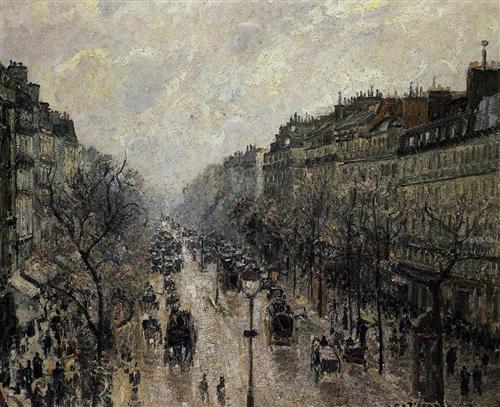
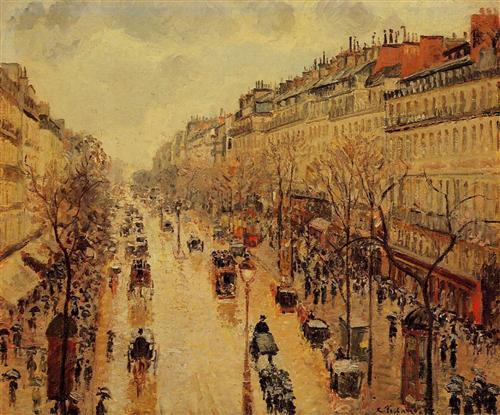
I mean, look at Camille Pissaro's collections of almost-identical paintings of the Boulevard Montmartre. Replace the carriages with motorcycles and compact cars and I swear that it looked pretty much the same today!


In a city steeped in history, it's still impressive to note that the neighborhood now known as Montmartre has existed since the time of Ancient Rome. It's from the Roman Gauls that the neighborhood has its name ... well, sort of. The Romans had originally named the area mons martis ("Mount of Mars") after the Roman god of war. However, this name was later "christianized" into mont martre ("Mount of Martyrs") in honor of Saint Denis. (As the story goes, this third-century missionary was decapitated on the hill that is now Montmartre ... after which point, he picked up his head and carried it through the streets of Paris, preaching all the while. Seriously. Google it.)

The Romans and early Christians did agree on one thing -- the whole mont aspect. Even today, when traversing the neighborhood on foot, it's definitely clear where the area's early inhabitants got the idea...


Of course, these stories -- though interesting -- aren't quite what comes to mind when you first think of Montmartre. It's not until the nineteenth century that the neighborhood became the stuff of paintings (and award-winning movie musicals). Because of its convenient location just outside the city limits, Montmartre quickly became -- and I quote from Wikipedia -- "a centre of free-wheeling and decadent entertainment." Around this time, in the mid-19th century, the neighborhood became a famous haven for artists, writers, and performers. Among the most famous patrons of the area were Vincent Van Gogh, Edgar Degas, Pablo Picasso, and even Langston Hughes!

Today, this area is hard to find, having been long since replaced by bustling souvenir shops and strip clubs, by discount grocery stores and overpriced cafés. However, if you can look past the postcard stalls of Sacre Coeur and the neon lights of the Pigalle district ... it's not to hard to find yourself in historic Montmartre.


Some of the remains of the iconic Montmarte cafés. La Bonne Franquette (pictured above, on the right) has been sitting in its location -- on la rue Norvins, the oldest street in Montmartre -- for over FOUR HUNDRED years. Read more about its fascinating history hereLe Consulat is another historic café, where cash-strapped painters like Monet and Toulouse-Lautrec reportedly used to pay their bills in artwork. 

Monday, July 7, 2014

A Rooftop with a View

Lundi, 7 juin.

Let's play a game. It's called "Guess where Elisabeth went today?!" Here's your first clue.


Don't know yet? Okay, I'll give you a hint. I was on top of a pretty famous building in Paris that's been providing great views of the city -- and a whole lot of other things -- for the past 100 years. This is what the inside looks like...


Is it ... a cathedral? A palace? A famous opera house? Nope, nope, and nope. In a city where castles are now museums and palaces were built for world exhibitions, this gorgeous building is actually a DEPARTMENT STORE.


Galeries Lafayette, to be specific.

Saturday, July 5, 2014

Tours and Towers of La Rochelle

Samedi, 5 juillet.

In the Middle Ages, English visitors to the port city of La Rochelle were struck by the pale limestone that provided the foundation for many of its buildings and gave the city a lasting nickname: la Ville blanche, or the White City. Walking around the city a couple of hundred years later, it's easy to see where they got the idea...


Despite its bland nickname, the city of La Rochelle has a fascinating and colorful history. (That being said, no shame if you're just here to look at the pictures!) Like much of the surrounding area, La Rochelle was inhabited first by the Gauls and then by the Romans, who were the first to exploit the region's potential for salt and wine production.

The city of La Rochelle as we know it today was not founded until the 10th century, around which time it was declared an independent commune. As a result, the city became the very first town in France to elect a mayor! More importantly, La Rochelle's autonomous status meant that the city was allowed to mint its own coins and was declared exempt from (some) royal taxes, which bolstered its economic status. La Rochelle became an important trading center in the Middle Ages, selling primarily salt and win. Although the city's location was great for trade -- allowing merchants to easily exchange goods with England, Spain, and the Netherlands -- it also made La Rochelle an attractive target. In the 12th century, England gained control of the city when its future king, Henry Plantagenet, married Eleanor of Aquitaine. (Yes, the same Eleanor of Aquitaine who was married to Louis VII of France in the Bordeaux Cathedral. Girlfriend got around.)


Over the next couple of centuries, the city was passed back and forth between the French and English. Its role as a port city is evident today: street signs reference old fish markets and a boulevard called le Cours de Dames marks where the wives of sailors would wait for the return of their husbands.

Although some of these historic clues are on the subtle side, the Vieux Port, or Old Harbor, is marked by three unmistakable towers, visible in the photo above. (You caught a glimpse of them in my earlier post, Snapshots of La Rochelle.) These tours de la Rochelle -- which include le Tour Saint-Nicholas, le tour de la Chaîne, and le tour de la Lanterne were constructed several hundred years ago as part of the city's defensive fortifications. The first two towers, which served as an entryway into the city's port starting in the fourteenth century, were connected by a large chain ... hence the name, tour de la Chaîne ("Chain Tower"). Today, it's possible to tour all three of the towers, which have been preserved as monuments nationaux since the 1800s.


The tour Saint-Nicholas, as seen from its neighbor, le tour de la Chaîne.

Located a little further down the ramparts, le tour de la Lanterne was built in the twelfth century and first used as a residence for the desarmeur des nefs, the officer who guarded the weapons of the various ships entering the port. (At this time, it was called the Tour de Garrot.) Following fifteenth century renovations, it was used as a lighthouse for a couple centuries before being converted into a medieval prison. At a striking 55 meters in height, it's the tallest of the three towers, and provides a panoramic view of the city and coastline.


The view from the first balcony, called the chemin de ronde.


Although le tour de la Lanterne is celebrated today for being the oldest lighthouse on the Atlantic coast, I think its history as a prison is MUCH more interesting. The tower's walls are full of graffiti, chiseled into the stone hundreds of years again by the sailors and pirates who were imprisoned there. Among these prisoners were thirteen priests, imprisoned and later killed during the Wars of Religion; their presence inspired another of the tower's names, le Tour de Prêtres.


What's left of a damier, or checkerboard, carved by prisoners.
  

Then I kept climbing... and climbing... and climbing...


Breathtaking, right?! The upper balcony, called la galérie, is only 38 meters in height. (I know, ONLY. But seriously, that's nothing compared the Strasbourg Cathedral.) But on all of my recent adventures, I've been on highly-fortified viewing platforms with loads of other tourists.

So between the waist-high railing, the high winds, and the fact that I was completely alone on the top of a medieval lighthouse ... I've got to say that the tour de la Lanterne was definitely the scariest place yet!

When my fear of heights kicked in... my hands were shaking when I took these photos!!